
How do I know if I'm happy?
How do I know if I'm happy? A practical reflection
This is one of the bravest questions a person can ask.
A life can look good on paper and still feel disconnected. Explore happiness through ordinary moments, your values and a gentle weekly reflection, without expecting yourself to feel good all the time.
The danger of living a life that only makes sense on paper
One of the easiest things to do in life is to slowly build a life around expectations instead of truth. You choose what feels sensible. Responsible. Impressive. Acceptable. And for a while, that works. You become successful at meeting external expectations. But many people never stop to ask:
Does this life actually feel aligned with who I am? Because happiness is difficult to measure externally. There's no universal checklist. No finish line where someone says:
"Congratulations. You've made it. You're officially happy now." And that uncertainty can feel deeply uncomfortable. Kafka once wrote:
"I was free, and that is why I felt lost." I think happiness can feel like that too. Wide open. Undefined. Personal. Which is why so many people avoid questioning it altogether.
Do I make choices from desire or from duty?
Think about your last few big decisions. Did they genuinely excite you? Or did they simply make sense? Did they keep everyone else comfortable? Did they protect you from uncertainty? There's nothing wrong with responsibility. But over time, living entirely from obligation can slowly disconnect you from yourself.
When I imagine my life being different, what changes?
Not fantasy. Not escape. Just honesty. What keeps appearing in your mind? More freedom? More creativity? More rest? More meaning? More connection? The things that repeatedly call to us are rarely random.
Are there parts of myself I quietly abandoned?
This question matters more than most people realise. Because often the version of ourselves we miss isn't dramatic. It's subtle. A part of you that used to feel curious. Creative. Playful. Alive. Somewhere along the way those parts got deprioritised in favour of productivity, responsibility or survival. But they usually leave clues behind. And part of happiness is reconnecting with those lost parts of yourself again.
How do I feel when everything gets quiet?
This may be the most honest question of all. Not when you're busy. Not distracted. Not consuming content. Just you. Alone with your own thoughts. Do you feel peaceful? Or vaguely restless? That feeling in the silence often tells the truth long before the mind is ready to admit it.
Happiness is not a permanent state
One of the biggest misunderstandings about happiness is believing it should feel constant. As though happy people wake up every day full of certainty, gratitude and joy. But real life doesn't work like that. Happiness moves.
Some days it's joy. Some days it's calmness. Or inspiration. Or laughter. Or feeling deeply connected to someone. Or simply feeling present in your own life again. And some days the best you can access is peace. That counts too. Because happiness is not perfection. It's not the absence of struggle. It's the feeling that your life is connected to something meaningful and true.
The deeper question
So maybe the question isn't actually:
"Am I happy?" Maybe the better question is:
"Am I alive to my life?"
Am I noticing it? Feeling it? Participating in it? Choosing it intentionally rather than simply moving through it automatically? Because many people are not deeply unhappy. They're just disconnected. Distracted. Overstimulated. Running on autopilot. And over time that disconnection can quietly become a life that no longer feels fully theirs.
Are you settling?
Sometimes we settle not because we lack potential but because we become attached to certainty. A familiar life can feel safer than an unknown one, even when it no longer feels fully aligned. But settling rarely feels dramatic. It feels like:
"It's fine." "I should be grateful." "Maybe this is just adulthood." And maybe sometimes it is. But sometimes it's also fear disguised as practicality. Fear of disappointing people. Fear of wanting more. Fear of beginning again.
Start there
You do not need to completely reinvent your life tomorrow. You don't need to have every answer. But you do owe yourself honesty. To pause long enough to ask:
What feels true for me now? What gives me energy? What parts of me want more expression? What would a more aligned life actually look like? Because the goal isn't chasing some perfect version of happiness. The goal is building a life that feels increasingly honest, alive and aligned with who you really are. One day at a time. And your day creates your life.
Look for patterns, not a verdict on one bad day
One difficult afternoon cannot tell you whether your whole life is right or wrong. Instead, spend a few minutes at the end of each day for a week noticing what happened.
When did I feel connected, interested or at ease? When did I feel drained or as though I was pretending? What mattered to me today, and did it get any room?
Include ordinary moments: a walk, a conversation, finishing something meaningful or resting without rushing. This is not a test to pass. You are looking for patterns that might be hard to see when everything feels like one big question.
Make one change that reflects what you notice
Read back over your notes. If connection keeps appearing in your good moments, arrange time with someone you feel comfortable around. If creativity is missing, make a small space for it. If you feel depleted every evening, the kindest change might be less pressure rather than another goal.
Choose one realistic action and put it in your week. Afterwards, ask whether it helped you feel more present or more like yourself. You can keep it, change it or try something else. You do not need a perfect routine to listen to your own life.
When reflection is not enough
Feeling unhappy does not mean you have failed to be grateful or intentional. Health, bereavement, money worries, discrimination and difficult circumstances can affect how life feels. You deserve support with those things, not another demand to think positively.
If low mood lasts for two weeks or more, or you are struggling to cope, speak to your GP or a qualified mental health professional. You can ask for help sooner, too. Balanse offers reflection and coaching, not diagnosis or treatment.
Key Takeaway
Maybe the better question isn't 'Am I happy?' but 'Am I alive to my life?' The goal is building a life that feels increasingly honest, alive and aligned with who you really are. One day at a time. And your day creates your life.
A gentle place to begin
Use the free Balanse Reset to reflect on what needs attention, or explore the vision workbook at your own pace. These are reflection tools, not mental health assessments.
Explore free resourcesFurther support: NHS advice on low mood and getting help.
See where you are
Five quick questions to show which part of your life needs attention first.
Take the Balanse Reset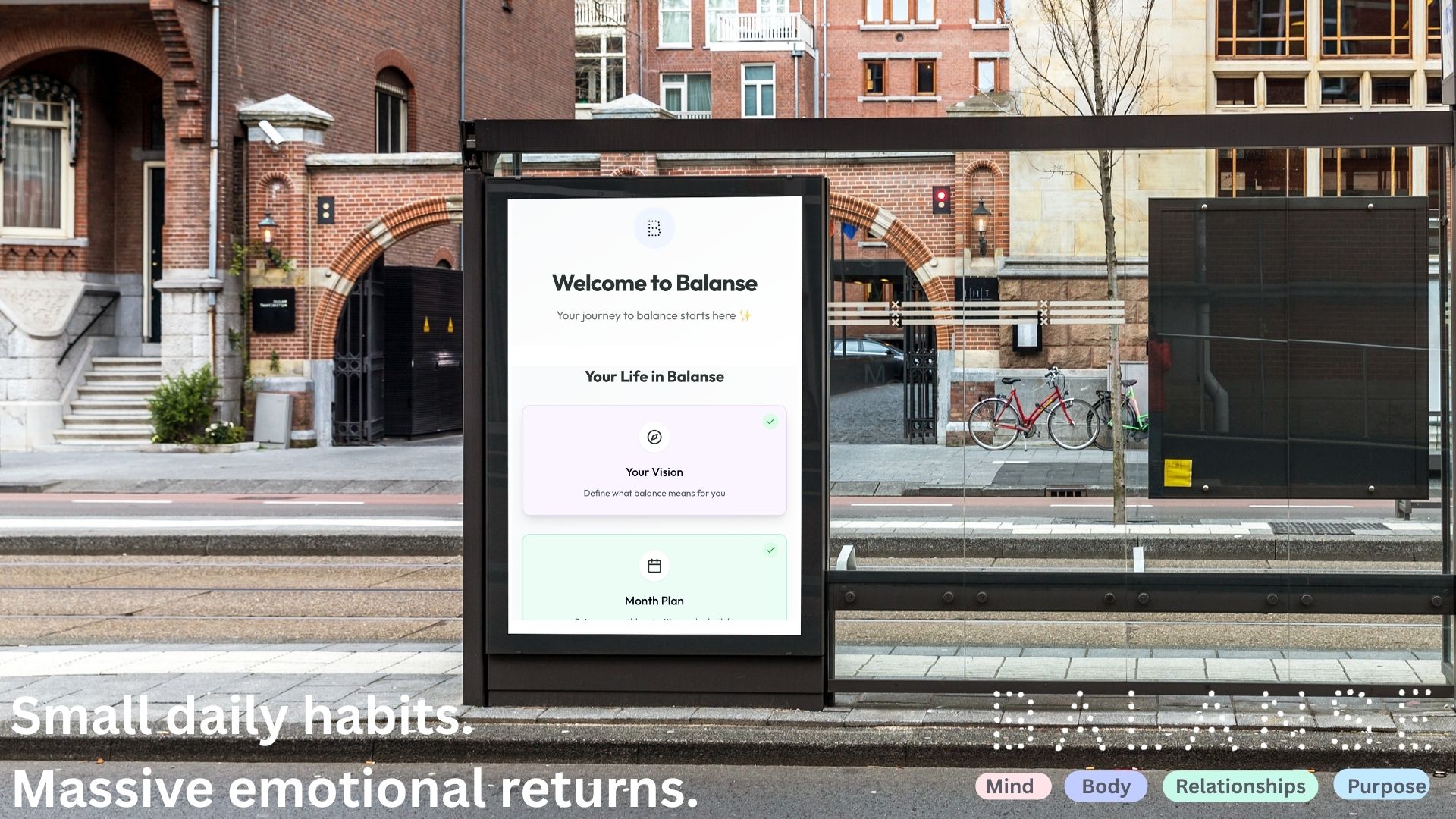

Small daily habits.
Massive emotional returns.
Everything you need to create a life of balance, purpose and fulfilment. Sign up today.