
Ask for what you want
Ask for what you want
You can't ask for something you haven't let yourself want.
Start with knowing what you want
Not what would look impressive. Not what other people expect. Not what seems sensible for someone your age. What do you actually want?
It's a harder question than it sounds. Many of us have spent years being the capable one, the one who keeps everything moving. We've become very good at knowing what everyone else needs, and quite vague about what we need ourselves.
So begin there, and build the want up in layers until it's clear enough to recognise when it arrives:
• The what. The desire in its plainest form. "More freedom."
• The specific. Add the details: who, where, how much, how often. "Fridays free to work on my own projects."
• The measurable. The part that can be counted, so you'll know when it's arrived. "Four Fridays a month by the summer."
• The feeling. How you want to feel once it's here. "Spacious. Trusted. Like my time is mine." This is the part your body will recognise.
• The full vision. All of it at once, in the present tense, as though you're standing in it. "It's a Friday in June. No meetings, no inbox. The morning is mine to build what I care about."
The middle layers turn a want into something you can ask for. The last two turn it into something you can feel. When I got clear about not being a fine-aholic and settling for less than I wanted in all aspects of my life, everything began to change. I stopped lowering my standards and decided to put my wants ahead of pleasing others and thereby hurting myself.
What your brain has been told to look for
Here's why that clarity matters so much. Your brain can't take in everything around you. It filters constantly, letting through a small amount of what's happening and quietly ignoring the rest.
You'll often hear this filter called the reticular activating system, or RAS: a network in the brainstem involved in alertness and attention. Psychologists describe the wider effect as selective attention. Put simply, you notice what you've decided matters.
You've seen it happen. You think about buying a particular car, and suddenly you see it everywhere. The cars were always there. What changed was what you were looking for.
The catch is that you've been setting that filter all along, usually without meaning to. If your days are full of worry, your attention is tuned to what could go wrong. If everything is "fine", it isn't tuned to much at all. If you only know what you don't want, that's exactly what keeps catching your eye.
When you get clear about what you do want, you give your attention a new brief. A conversation you'd have half-listened to becomes an opening. A person you'd have walked past becomes someone worth knowing. An opportunity you'd have scrolled straight past makes you stop. It isn't magic. It's noticing.
Noticing isn't enough. You still have to ask.
Seeing the opportunity is only half of it. The other half is saying the words.
This is where most of us stop. We fear the no. We worry the want is too much, or that we haven't earned it yet. Our heart races, our words get stuck, and we decide on the other person's behalf that the answer would have been no anyway.
That feeling isn't weakness. It's your nervous system trying to keep you safe. But safe and small are not the same as happy.
The fear underneath the fear
For many of us, the fear isn't really about hearing no. It's quieter than that, and it gets there first.
It's the fear that what we want isn't valid. That it's too much, too selfish, too late. That other people have real problems, so who are we to want more rest, more money, more love, more joy?
And underneath that, often, is an even older fear: that we're not worthy of receiving it. That good things are for other people, or for some future version of us who has finally earned them. Thinner, calmer, more successful, more healed, more sorted.
So we do something clever. We pre-reject ourselves. We decide the answer is no before anyone else gets the chance, and we call it being realistic. We shrink the want until it feels safe enough to say out loud, then wonder why the small version never quite satisfies.
This fear rarely starts with us. Many of us learned early that wanting was risky. That being easy, helpful and undemanding kept us safe and loved. That our needs were an inconvenience. Those beliefs made sense once. They protected us. But they were never the truth about our worth.
Here's what I've come to believe. Your desire doesn't need a reason to be valid. You don't have to justify it, earn it or prove you've suffered enough to deserve it. And worthiness isn't something you reach at the end of the work. It's where you start from.
You don't have to feel fully worthy before you ask, either. You can ask while still unsure. You can feel the old voice saying "who do you think you are?" and ask anyway. Each time you do, you gather a little evidence that wanting didn't break anything, and that you're still here.
Notice how easily you'd tell a friend that she deserves good things. Then ask yourself why the same rule doesn't apply to you. I remember asking the most incredible people to meet me about a specific business proposition when I was running Sustainably and even though I was scared, I still did it. I could have talked myself out of it because I didn't feel I deserved it, but I asked anyway.
How to ask
• Name it specifically. The clearer the want, the easier it is for someone to say yes.
• Ask as an invitation, not a demand. Instead of "I need you to…", try "I would love it if…" or "What would it look like if…". People say yes more easily when they still feel free to say no.
• Say it, then stop talking. The silence afterwards feels long. Let it.
• Treat a no as information. Ask what would need to be true for the answer to be yes, and when you could come back to it.
• Start small. A different table. Help with a task. An extra day on a deadline. Asking is a muscle, and small asks build it.
Asking trains your attention too
Every time you ask for something, you tell your brain again that it matters. And the more it matters, the more you notice the next opening.
It becomes a loop. You get clear on what you want. You start noticing the opportunities. You ask. Some of the answers are yes, and that's evidence. Evidence builds belief, and belief makes the next ask easier.
Key Takeaway
Knowing what you want tells your brain what to look for. Asking for it is how you act on what you find. Your desires aren't greedy. They're information about who you're becoming, and asking for them is an act of self-respect.
Make it a daily habit
A 60-second daily check-in, planning for your day, week and month, and a coach that remembers what matters to you.
Start your free 14-day trial of the BalanseOS app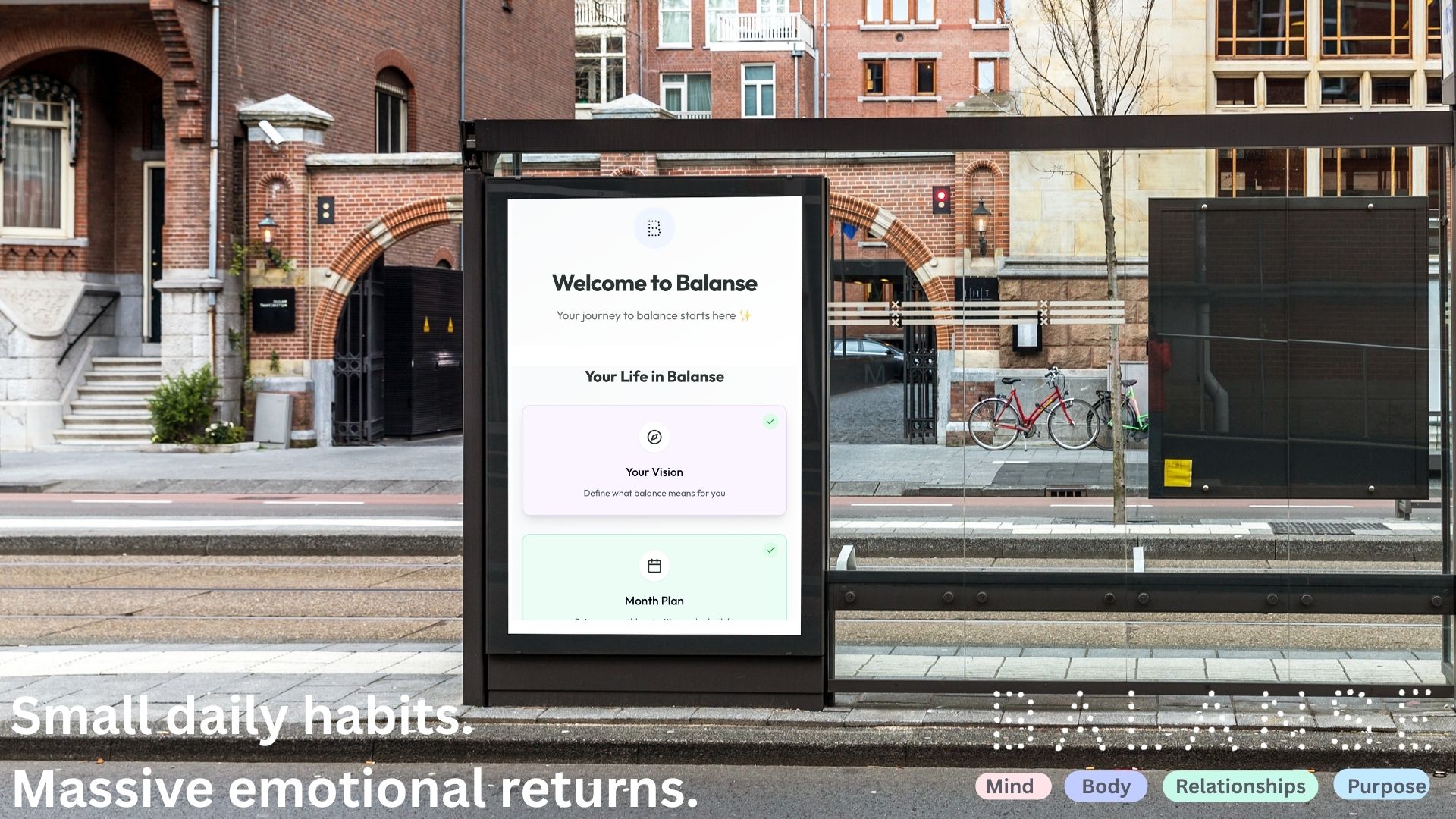

Small daily habits.
Massive emotional returns.
Everything you need to create a life of balance, purpose and fulfilment. Sign up today.